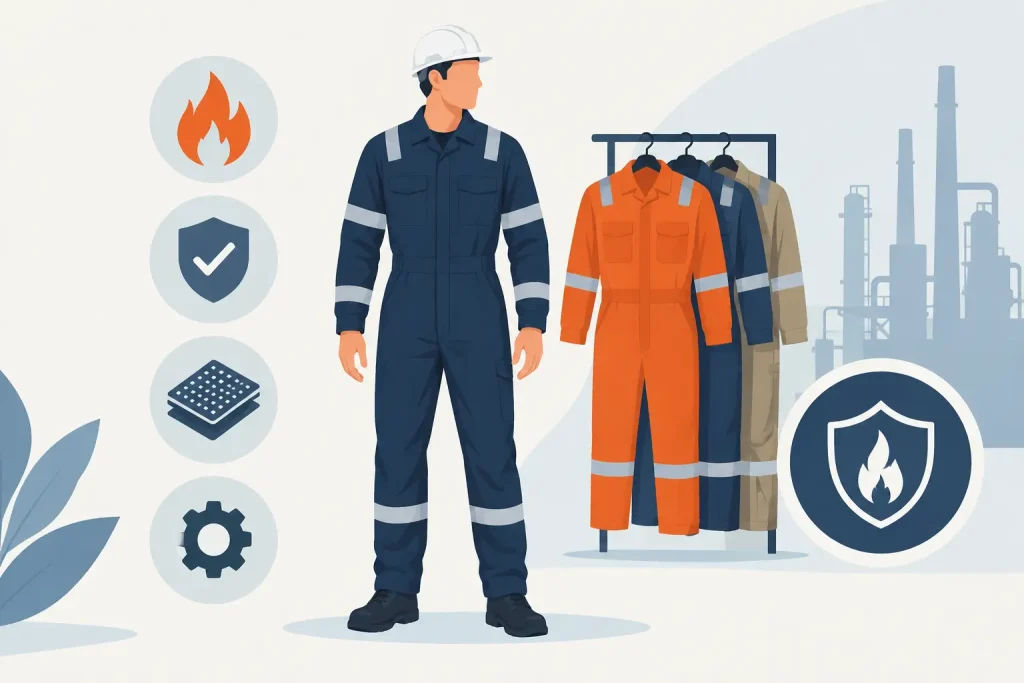
A coverall that feels acceptable on a station floor can become a restriction, a heat burden or a point of failure when the incident changes. To choose fire resistant coveralls properly, start with the exposure your team faces, not a colour, price point or generic claim of flame resistance. The correct garment must protect the wearer against the identified thermal risk while allowing them to move, communicate, work and recover safely.
Fire resistant clothing is not fireproof clothing. It is designed to resist ignition, limit flame spread and, for the relevant certified garment, provide a defined level of protection against specific heat hazards. The protection only works when the coverall, its layers, its fit and its condition are suitable for the task.
Start with the hazard, not the garment
A coverall specified for brief, intermittent flame exposure may not be appropriate for electric arc work, molten metal splash, flash fire risk or a multi-hazard operational environment. The first question for a procurement lead or team commander is therefore: what can realistically expose the wearer to heat, flame or ignition?
Consider the source of the hazard, assess secondary hazards. Weather exposure, static electricity, visibility requirements, contamination, abrasion and the need to wear respiratory protection, harnesses or body armour can all affect the final choice. The carriage of kit on a fire tender has to be controlled as space is limited. A suit that can be utilised for a number of end uses due to its carefully considered design and certification is more cost effective and uses less space on a fire tender than three differing suits for three differing end uses. Flight operations introduce their own risks, including confined workspaces, fuel exposure and the need for unrestricted mobility when seated or climbing.
Also A fire resistant coverall is one part of a protective system, not a substitute for sound incident control, training or suitable personal protective equipment.
Inherent or treated flame resistance
Fire resistant coveralls generally achieve their properties in one of two ways. Inherently flame-resistant fabrics use fibres with built-in resistance to flame. Their protective characteristic is not dependent on a surface treatment, and is retained throughout the operational life of the garment. Treated fabrics are chemically finished to achieve flame resistance and are significally cheaper to initially purchase. But with a limited life span and the added responsibility on the employer to maintain accurate laundering records according to the manufacturer’s instructions, these can work out more expensive in the long term.
Inherent fabrics are a strong choice for frequent laundering and long service life. Compare the certified performance after the expected number of wash cycles, garment durability, repairability and the reality of your laundry process.
Choose fire resistant coveralls for movement and layering
Protection that prevents the wearer from operating properly creates another risk. A coverall should allow a full reach, deep bend, kneeling position, step-up movement and seated tasks without pulling tightly across the back, crotch or shoulders. Fit is particularly significant because trapped air can contribute to thermal insulation, but excessive looseness can snag on equipment or reduce practicality in confined spaces. The right answer is a properly sized garment with enough ease for operational movement, not simply the largest available size.
Pay close attention to sleeve and leg length, especially for teams with a broad range of body shapes. The use of stretch modern materials and gender specific fits as well as two-way front zips. These can improve comfort and access. Covered fastenings and protected metal components can reduce heat transfer and help prevent snagging.
Layering must also be planned. Moisture-wicking, flame-resistant base layers can support comfort and help manage sweat, whereas ordinary synthetic base layers may melt when exposed to heat. If personnel will wear thermal layers or stormwear over the coverall, assess the complete ensemble. The outer layer must not compromise access to pockets, harness points or equipment, and it must be compatible with the risks identified.
Specify the details that support the mission
Reinforcement at knees, elbows and high-wear areas can extend service life, provided it does not undermine performance and comforts where mobility is needed. Radio loops, identity panels, rank slides and attachment points should be positioned for the operational role rather than added as an afterthought.
Buy for the full issue cycle
The cheapest unit price rarely represents the lowest operational cost. Consider expected wash cycles, repair options, availability of replacement sizes, lead times and whether the supplier can maintain a consistent specification over time. Teams often need rapid replacement after damage, contamination or deployment, so continuity of supply matters.
For mixed teams, a flexible issue programme is equally valuable. No minimum order quantities, professional measurement support and the ability to add approved embroidery, printing or woven badges can prevent staff from being placed in ill-fitting or inconsistent clothing simply because a standard stock range does not meet their needs. Rig Equipment supports this kind of practical, service-specific development alongside British-based manufacture and certified materials.
A well-chosen coverall gives personnel one less uncertainty to manage when conditions deteriorate. Build the decision around the real hazard, verify the certified performance, involve the wearers in fit trials and maintain the garment with the same discipline applied to every other piece of critical equipment.