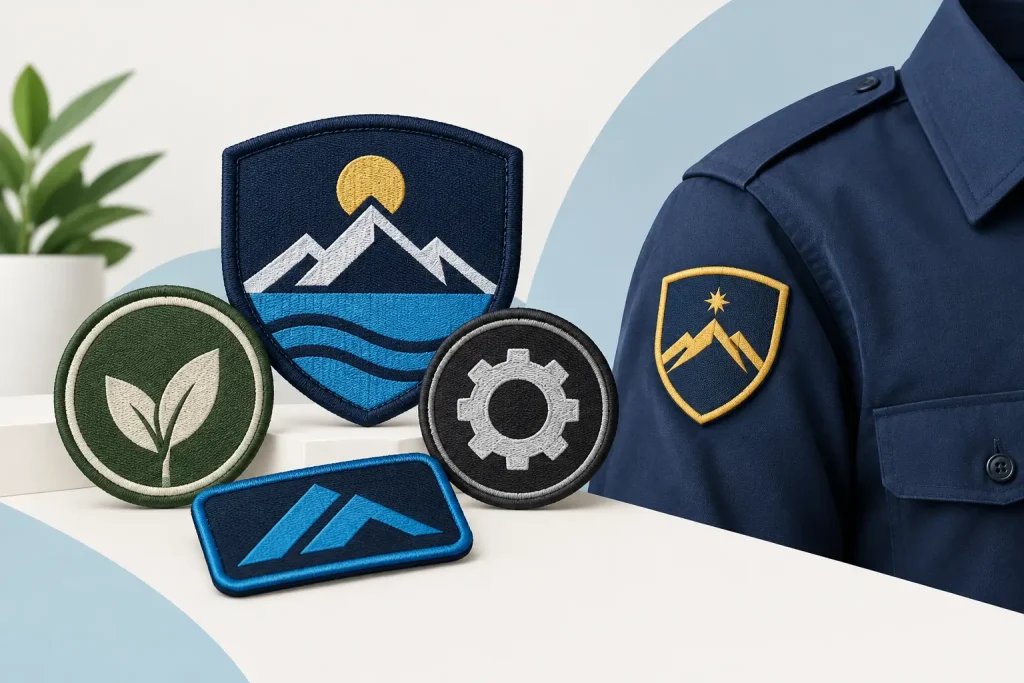
A badge that curls at the edge, loses its lettering or detaches during a callout is more than a presentation issue. It can weaken team identification when conditions are already difficult. Custom woven uniform badges give emergency service, defence and specialist response teams a precise, durable way to display unit names, roles, ranks and service identity on operational clothing.
Badge construction, placement and attachment method must work with the garment, the task and the expected service life. A flight suit, flame-retardant jacket and waterproof storm layer each place different demands on the same badge.
Why woven badges suit detailed operational identification
Woven badges are made by weaving fine threads together to form the design, rather than building the image from raised stitched embroidery. This produces a flatter finish and allows for crisp small text, fine lines, symbols and colour transitions. Where a team crest includes a complex emblem, a long station title or a specialist qualification, woven construction often gives clearer results than embroidery.
That clarity matters at close range and in professional settings where names, roles and insignia must be readily understood. Woven badges also sit neatly against uniforms, reducing bulk around chest, sleeve and shoulder positions. On garments worn beneath body armour, harnesses or outer layers, a low-profile finish can be particularly useful.
However, when directly applied badges on to the garment fabric is required, Embroidered badges are more practical. A raised, traditional appearance can be the better choice where bold lettering and a direct application are wanted. Woven badges are generally the stronger option when detail and a clean, controlled profile take priority. The right choice depends on the complexity of the design, the uniform fabric and the operational environment.
Specify the badge for the garment, not just the artwork
A badge should be treated as part of the uniform specification. Before production, establish where it will be worn, the dimensions and shape required. What it needs to communicate and how often the garment will be laundered, repaired or reissued. This prevents a well-designed badge becoming unsuitable once it reaches service.
Start with legibility at the finished size
Artwork that looks clear on a screen can become unreadable at 70 mm wide. A good badge design retains its identity when viewed at the size actually used on the garment.
It is also worth distinguishing between ceremonial identity and operational recognition. A formal crest may need every heraldic detail preserved. A response team patch used on field clothing may benefit from a simplified design that remains clear under torchlight or through a vehicle window.
Match the attachment method to the duty
Sew-on badges are a dependable permanent solution for garments that retain a fixed identity throughout their life. They are well suited to issued uniforms, shirts, tunics and outer layers where the badge is not expected to change between tasks.
Hook-and-loop backing is practical where teams need to change identifiers by role, deployment, agency or security requirement. It supports rapid replacement and simplifies laundering or garment repair, but it must be specified carefully. Poorly matched hook-and-loop can lift at corners, collect debris or add avoidable bulk. The placement also needs to avoid interference with rucksack straps, body armour, harnesses and seat restraints.
Heat-applied backing can be appropriate for certain fabrics and lower-stress applications, but it should never be assumed suitable for every operational garment. Heat, coating, stretch, washing process and flame-resistant properties all affect the decision. Operational clothing is selected for specific protection, comfort and durability requirements. A badge must not undermine them. This is especially significant with flame-resistant, waterproof, breathable or high-visibility garments. British-based design and manufacture can make this process easier when a project needs direct discussion, physical sampling or quick correction. For specialist teams, a badge supplier should understand that the item will be used in real duty conditions, not simply displayed on a retail garment.