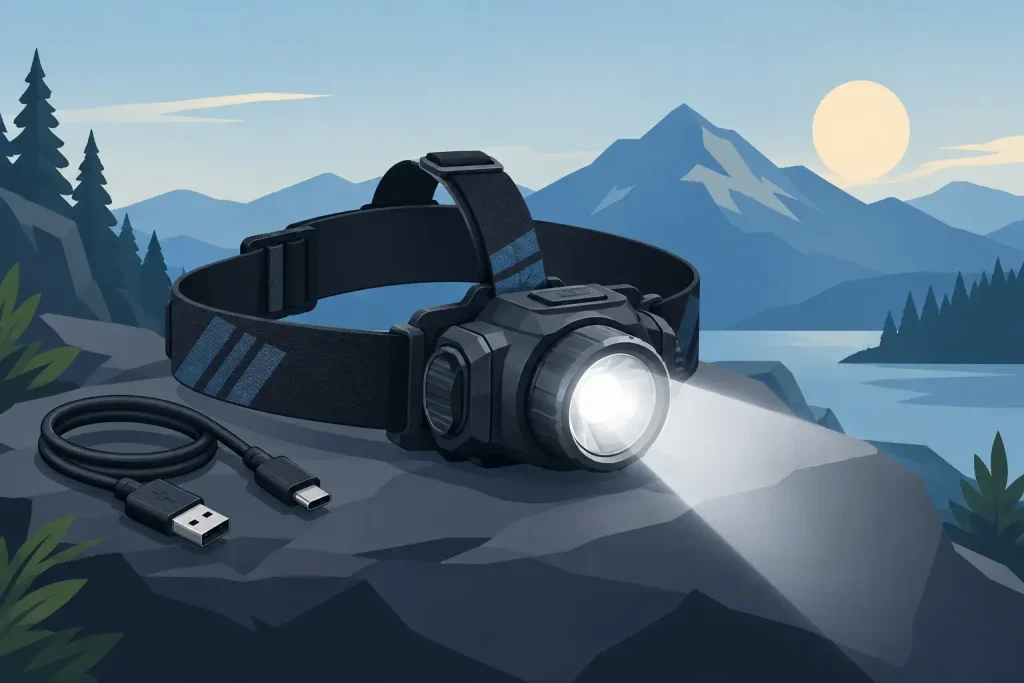
A casualty search does not pause because a battery is flat, a glove cannot find the switch or a head torch shifts on a helmet. For emergency response, defence and search teams, a rechargeable tactical head torch is not simply a convenient light source. It is part of the working system that supports safe movement, hands-free treatment, communications, navigation and task completion in poor visibility.
The right specification depends on the role. A responder working around water needs different priorities from a firefighter operating in smoke, a flight crew member preserving night vision or a tactical operator moving discreetly. The practical question is not which torch has the highest advertised output. It is whether the light will perform predictably throughout the task, on the issued helmet or headwear, in the weather and under the controls required by the team.
What a rechargeable tactical head torch must do
A tactical head torch should provide usable light rather than impressive figures on packaging. High output has a place when searching open ground, identifying a route or scanning a shoreline. It can also create reflected glare from rain, mist, snow, white PPE, maps and nearby surfaces. A well-specified torch therefore needs more than a powerful maximum mode. It needs a controlled low setting for close work, a practical medium setting for movement, and a high setting that can be used when the scene demands reach.
Beam pattern matters as much as output. A broad flood beam is valuable for casualty care, equipment checks, rope work and moving over uneven ground because it lights the immediate working area without constant head movement. A more focused spot beam carries further for search and route finding. Many operational users benefit from both, but the switching arrangement must be simple enough to use without looking at the unit.
Controls should work with wet hands and insulated gloves. A positive, well-spaced switch reduces accidental activation inside a kit bag and allows the wearer to identify the required setting by feel. Consider whether the torch remembers its previous mode, whether it cycles through unwanted flashing functions and whether a lockout is available. Strobe settings may have a role for signalling, but they should not sit in the normal operating sequence where they can be selected by mistake during patient care or a low-profile approach.
Runtime is a shift-planning issue
Published runtime figures can be misleading if they are quoted only at the lowest output. Assess runtime at the mode that will actually be used. A torch that delivers a short burst of high output before stepping down may still be suitable, but teams need to understand its sustained performance rather than rely on the headline lumen figure.
For planned deployment, calculate lighting around the full duty period, likely task intensity and a sensible contingency. Cold conditions reduce lithium-ion battery performance, while constant high-output use, flashing modes and frequent activation can shorten service time. A clear battery-status indicator is useful only if it can be checked quickly and interpreted without ambiguity.
Rechargeable power reduces the burden of carrying and disposing of single-use cells, particularly where torches are used regularly for training, routine checks and extended incidents. It also introduces a charging discipline. The torch, cable, charging cradle or spare battery system must be managed as part of pre-deployment preparation, not left until the vehicle is mobilised.
A removable battery can support longer operations if spare packs are approved, protected and carried correctly. An integrated battery may improve weather sealing and simplify the unit, but it can leave the user waiting for a recharge after the cell is depleted. Neither approach is automatically better. The appropriate choice depends on whether the team can access vehicle charging, mains power, portable power or controlled battery replacement during an incident.
Selecting a rechargeable tactical head torch for the environment
Water resistance should be selected for the exposure expected, not for a best-case forecast. Rain, sea spray, mud and brief immersion create different demands. Check the manufacturer’s stated ingress protection rating and understand what it covers. A rating for water splashes is not the same as one intended for immersion, and a charging port cover must be correctly closed to maintain protection.
For maritime, coastal and flood-rescue users, saltwater exposure also places pressure on contacts, charging connections and adjustment mechanisms. Rinsing, drying and inspecting equipment after deployment helps preserve reliable operation. Any torch used near water should be secured against loss, particularly when fitted to a helmet that may be removed during a rescue.
Fire and rescue environments require additional care. Heat, smoke, chemical contamination and the need to operate around breathing apparatus can affect both the choice and placement of the light. Do not assume that a torch is safe for a potentially explosive atmosphere because it is marketed as tactical or professional. Where ATEX, IECEx or another hazardous-area approval is required, the exact model and certification must be checked against the organisation’s risk assessment and operating procedure.
Red, green or other coloured light can be useful, but only when it supports the task. Red light may help preserve adapted night vision for navigation or low-light administration, while coloured modes can assist team identification or map reading. These functions are secondary to a dependable white working beam. They should be selected for a defined operational reason, not because they add features to a specification sheet.
Helmet mounting and fit are operational details
A torch worn directly on the head is often suitable for walking, camp tasks, low-risk searches and work where a helmet is not required. During technical rescue, fire response, water operations or tactical deployment, helmet mounting may be the safer option. The mount needs to suit the issued helmet shell, rails, clips or attachment points without compromising the helmet’s approved configuration.
Check that the torch can be tilted through a useful angle. A beam fixed too high can dazzle colleagues; one that cannot be directed downwards makes close work harder. Weight and balance also matter. A large battery pack at the front of the helmet can increase neck fatigue over a long shift and may snag when entering confined or obstructed spaces.
Compatibility should be tested with eye protection, face shields, communications headsets, hearing protection and cold-weather hoods. A torch that fits an empty helmet may interfere with other essential PPE when the system is worn as intended. Procurement teams should trial representative samples with end users, across the range of helmets and roles in service, before committing to a wider issue.
Build a lighting system, not a single point of failure
The head torch is normally the primary hands-free light, but it should not be the only light available. A compact handheld torch gives a colleague a way to direct light independently, inspect a space from a different angle or continue work if the helmet is removed. Vehicle, scene and area lighting have their own place. Each layer reduces the operational impact of one failed component.
This does not mean issuing the biggest quantity of equipment. It means setting clear expectations: which light is carried, where it is worn, how it is checked and what constitutes an unserviceable item. A damaged lens, loose mount, swollen battery, unreliable switch or compromised charging port should trigger withdrawal and inspection rather than an improvised field repair.
For organisations, standardising a small number of approved models can simplify training, charging provision, spares and replacement. It also means crews learn the same control sequence and battery indication across teams. At Rig Equipment, the most useful selection process begins with the operational environment and issued PPE, then works back to the lighting specification – not the other way around.
Care, charging and readiness checks
Rechargeable equipment earns its value through consistent maintenance. After use, clean the torch according to the manufacturer’s instructions, paying attention to seals, lens edges, mounts and contacts. Do not charge a unit that is visibly damaged, excessively hot or contaminated until it has been assessed.
Use the approved charging equipment and follow local battery safety procedures. Charging in a controlled, visible area is preferable to leaving units connected in lockers, kit bags or unattended vehicles. If a team stores equipment for extended periods, battery condition should be checked as part of scheduled inspections rather than discovered at the next callout.
Before deployment, confirm the torch turns on, changes modes correctly, locks out if applicable, shows adequate charge and remains secure on the chosen mount. This check takes moments. In darkness, wind, rain or smoke, it may be one of the checks that makes the rest of the task safer.
Choose a torch that matches the conditions your people actually face, issue it with a clear charging routine and make its use familiar before it is needed. Dependable light is built into readiness long before the incident begins.