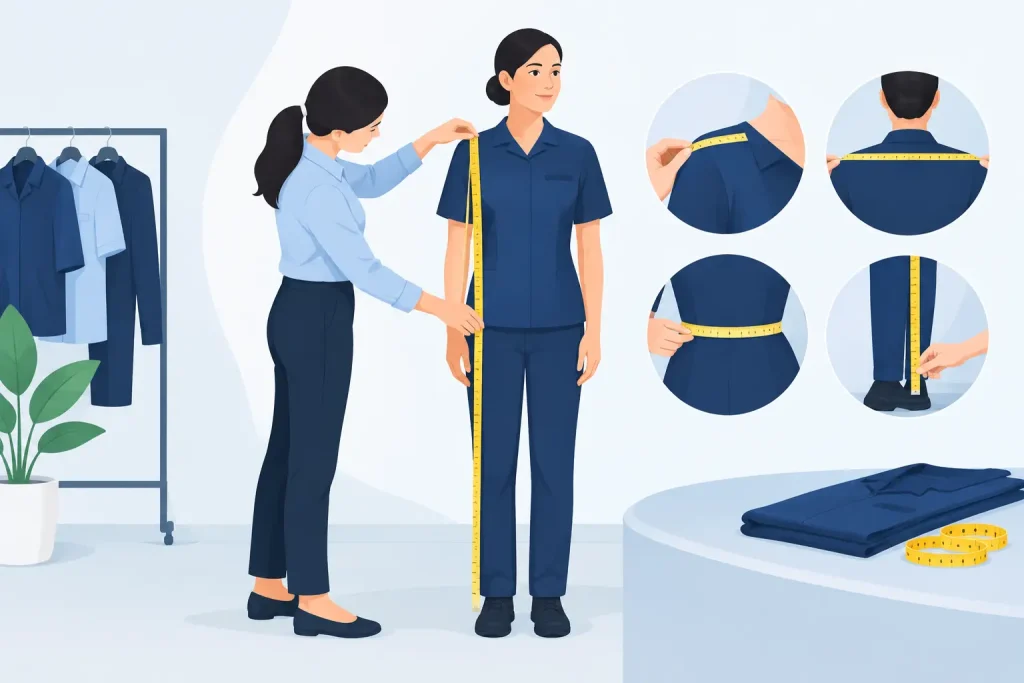
A jacket that binds when reaching for a casualty, trousers that catch at the knee, or a sleeve that rides above a glove can distract from a task that demands full attention. Knowing how to measure operational uniforms correctly helps protect mobility, preserves the intended coverage of protective clothing and gives every team member a professional, dependable fit.
Operational sizing is not the same as choosing everyday clothing. Emergency service and defence personnel often work in changing weather, wear base layers and PPE, carry equipment and move through confined spaces. Measurements must reflect the wearer’s working position and the layers they will use, not simply their preferred fit in casual clothes.
How to measure operational uniforms for service use
Measure the wearer over lightweight base clothing, such as the type of undergarments or base layer normally worn on duty. Do not measure over a bulky fleece, waterproof outer layer or body armour unless the garment specification explicitly calls for it. A flexible tailor’s tape measure is essential. Keep it level, close to the body and firm without pulling it tight.
Where possible, have a colleague take the measurements. Self-measuring commonly leads to a raised shoulder, an uneven tape line or an inaccurate waist reading. Record every figure in centimetres, then compare it with the sizing chart for the specific garment. A medium in one product is not automatically the same as a medium in another, particularly where flame-resistant garments, flight suits and weather layers are designed to different patterns.
Before starting, ask what the uniform is required to do. A coastguard responder needing room for thermal layers and a flotation device may need a different fit allowance from a medical responder working mainly indoors. A close-fitting flame-resistant base layer has a different purpose from an outer storm jacket. The correct size is always tied to the role, garment construction and equipment worn with it.
The core body measurements
For most operational jackets, shirts, combat trousers, coveralls and outerwear, five measurements provide a reliable starting point:
- Chest: Measure around the fullest part of the chest, keeping the tape horizontal under the arms and across the shoulder blades. The wearer should breathe normally and keep their arms relaxed.
- Waist: Measure around the natural waist, usually the narrowest part of the torso above the hip bones. Do not rely on the waistband size of existing trousers, as this can vary considerably between brands and garment styles.
- Hip or seat: Measure around the fullest part of the hips and seat, with feet together. This is particularly important for waterproof trousers, coveralls and garments that need unrestricted crouching movement.
- Inside leg: Measure from the crotch seam to the point where the trouser hem should finish. Take this measurement while the wearer is standing straight in duty footwear, or allow for the boot height specified for the garment.
- Sleeve length: Measure from the centre back of the neck, across the shoulder and down the outside of the arm to the wrist. This reflects reach more accurately than measuring only from shoulder to wrist.
For coveralls and flight suits, torso length is equally significant. Measure from the base of the neck, down through the legs and back to the same point, following the body’s line. This prevents excessive tension across the back and crotch when sitting, climbing or reaching overhead. If a product sizing guide uses back length instead, follow that guide rather than substituting a different measurement.
Take measurements in a neutral stance
The wearer should stand naturally with feet around shoulder-width apart. They should not hold their breath, pull in their stomach or over-straighten their posture. These small adjustments can produce a uniform that looks correct at issue but becomes restrictive during a long operational period.
It is useful to repeat key measurements, particularly chest, waist and inside leg. If two readings differ, take a third and record the average only if the tape placement was consistent. For teams being measured at scale, use one trained measurer and one agreed method. Consistency protects against avoidable variations between stations, teams or issue dates.
Fit allowances matter as much as the numbers
Body measurements identify the starting size. Fit allowance is the additional room built into a garment so the wearer can work, layer clothing and use protective equipment. The amount required depends on the item.
A technical base layer should sit close to the skin to manage moisture effectively, but it must not restrict breathing or shoulder movement. A station shirt may need enough room to reach, drive and wear under a protective layer. Stormwear requires space for insulation and mid-layers, while still allowing cuffs, hems and collars to seal effectively against wind and rain.
Avoid automatically sizing up for every operational garment. An oversized outer layer can snag, interfere with harnesses, leave too much fabric around the hands and make equipment access slower. Conversely, sizing down to achieve a neat appearance can reduce mobility and compromise coverage. The correct choice is the size that works with the planned clothing system and the wearer’s range of movement.
For fire and rescue or other heat-exposed duties, follow the garment manufacturer’s instructions exactly. Protective performance can depend on the specified air gap and layering arrangement. Altering the fit without professional advice may affect the garment’s intended protective function.
Test the fit in operational movements
Measurements are only the first check. Once a sample garment is available, assess it in movements that reflect the wearer’s duties. The wearer should raise both arms, reach forward, kneel, squat, climb a step, sit in a vehicle position and bend to pick up equipment.
Check that the back does not pull sharply across the shoulders, the crotch does not bind, and the knees and elbows align with their intended reinforcement areas. Jacket cuffs should continue to overlap gloves when arms are extended. Trouser hems should work with operational footwear without dragging under the heel or riding high above the boot.
If body armour, a buoyancy aid, harness, radio belt or load carriage system is issued, test it with the uniform. A garment that fits well in isolation may become restrictive once the full system is worn. Pay particular attention to pocket access, collar position, shoulder movement and any pressure points created by straps.
Measuring specialist items beyond clothing
A uniform programme is rarely limited to shirts and trousers. Several related items need their own measurements or fit checks.
Headwear and helmets require head circumference, measured around the widest part of the head, just above the eyebrows and ears. A helmet must then be adjusted and tested for stability, compatibility with eye protection, communications and any respiratory equipment. Never select a helmet solely from a cap size.
For gloves, measure hand circumference around the knuckles, excluding the thumb, and hand length from the wrist crease to the tip of the middle finger. The right glove must allow dexterity for fastenings, communications and medical tasks while providing the required protection. Gloves that are too large can reduce control; gloves that are too tight can fatigue the hand and restrict circulation in cold conditions.
Footwear should be assessed with the socks worn on duty, preferably later in the day when feet may be slightly larger. Allow enough toe room for descents and prolonged standing, but ensure the heel remains secure. A boot that feels acceptable for five minutes can become a serious problem during a twelve-hour deployment.
Record measurements and plan for change
For organisational issue, keep a confidential measurement record alongside garment size, product code, length option, date of issue and any approved alteration. This supports accurate replacement orders and reduces repeated fitting time. It also makes it easier to identify recurring issues with a particular cut, role or cohort.
Measurements should be reviewed when a wearer reports poor mobility, changes role, returns after an extended absence or experiences a significant change in body shape. They should also be checked before ordering a new garment range. Patterns, fabric weights and intended layer systems differ, even when the nominal size remains familiar.
Alterations can resolve certain problems, such as trouser length or sleeve length, but they are not a substitute for selecting the correct base size. On protective garments, any alteration must be suitable for the fabric, construction and certification requirements. Repairs and modifications should retain the garment’s intended performance rather than simply improve appearance.
For larger issues, a structured fitting session is the most reliable approach. It gives procurement teams the opportunity to check size distribution, validate samples with operational users and identify bespoke requirements before committing to production. Rig Equipment can provide professional measurement guidance where teams need a practical, service-specific approach.
A well-measured uniform should become unremarkable once duty starts. It should move when the wearer moves, support the equipment they depend on and remain comfortable enough that attention stays where it belongs: on the task, the team and the people relying on them.