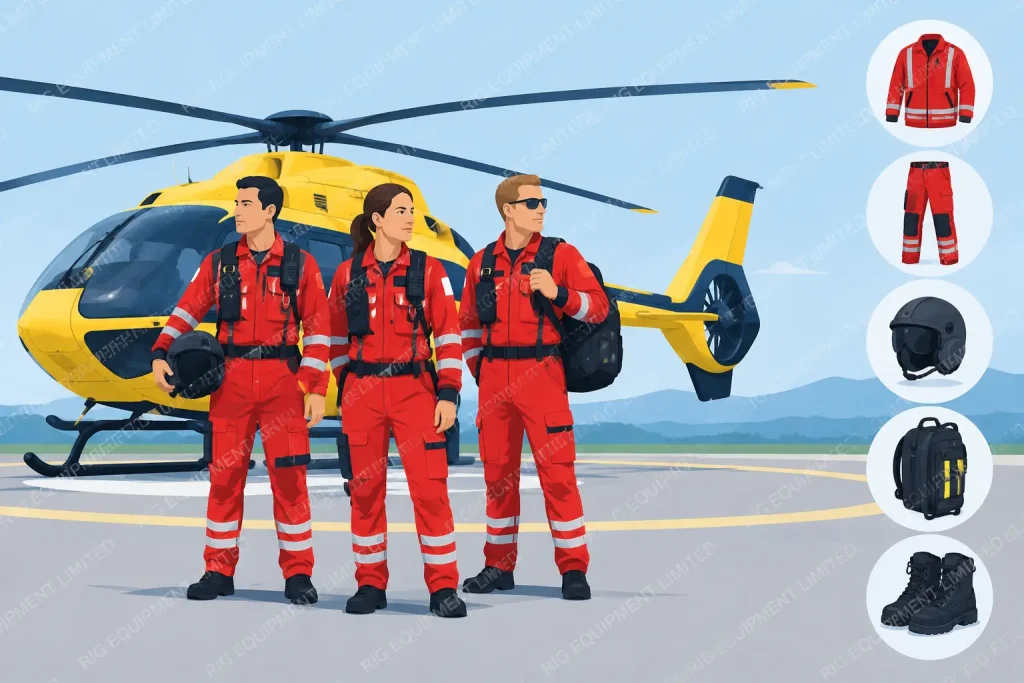
A HEMS shift can move from a cold aircraft walk-round to a roadside clinical intervention, then into a heated hospital corridor within minutes. Clothing has to keep pace without restricting movement, compromising hygiene or adding unnecessary bulk. This air ambulance clothing guide sets out the factors that matter when selecting garments for crews who work across flight operations, urgent patient care and exposed landing sites.
Clothing must support the whole mission
Air ambulance uniform is not simply medical workwear with a high-visibility panel. Crews face a distinct combination of risks: rotor wash, noise, fuel and aviation hazards, poor weather, confined aircraft cabins, manual handling and close patient contact. They must remain recognisable to partner agencies while being able to access equipment, communicate clearly and work with precision.
That range of activity creates competing requirements. A heavily insulated jacket may protect against wind on scene but become restrictive in the aircraft or too warm during treatment. A lightweight clinical top may be comfortable indoors yet offer little resilience during an extended roadside incident. The right specification is therefore built around the mission profile, not a single product category.
For procurement teams, the starting point should be an honest assessment of where crews spend time, how long they are exposed to the elements and which tasks demand the greatest freedom of movement. The answers may differ between day-car operations, helicopter teams, inter-hospital transfer crews and specialist retrieval services.
Air ambulance clothing guide: begin with task analysis
Before selecting fabrics, colours or pocket layouts, map the operational sequence. Consider pre-flight checks, aircraft loading, patient transfer, clinical interventions, refuelling areas, landing-site operations and handovers. Each stage affects what the wearer needs from their clothing.
Flight operations and aircraft movement
Garments worn around aircraft should be close fitting enough to reduce snag and flap risk, particularly around cuffs, hems and loose accessories. This does not mean restrictive. Crews need reach through the shoulders, bend at the waist, kneel and step up into aircraft safely. Articulated knees, well-positioned stretch panels and a correctly shaped sleeve can make a meaningful difference over a long shift.
Pocket placement also deserves close scrutiny. Pockets should remain accessible when seated and restrained, without creating pressure points or obstructing harnesses. External features need to be purposeful. A pocket that cannot be used with gloves, or that catches on aircraft fittings, adds complexity rather than capability.
Clinical care under pressure
During patient care, uniform must allow quick, clean access to essential items while maintaining a professional appearance. Fabrics should be durable enough for repeated laundering and able to withstand the abrasion associated with kneeling, lifting and working around vehicle interiors.
This is also where layering matters. A crew member should be able to regulate their temperature without repeatedly removing and replacing awkward outer garments while managing equipment and patients. Low-bulk layers support this far better than a single heavy garment.
Remote and roadside scenes
Landing sites are rarely controlled environments. Crews may work in rain, wind, mud, long grass or on hard standing, often alongside fire and rescue, police and ambulance colleagues. Outer layers need weather resistance appropriate to the service area, along with durability at high-wear points such as knees, elbows, shoulders and seat panels.
Visibility is essential, but it must be considered as part of the full garment system. A high-visibility outer layer is only effective when it is worn, remains clean and fits properly over the layers beneath it. Reflective detailing should support recognition in low light without interfering with role markings, aircraft procedures or the service’s established identity.
Build a layer system, not a uniform bundle
A dependable clothing issue works as a system. It gives each crew member practical options for changing weather, seasonal temperature shifts and varied duty patterns, while keeping the overall appearance consistent.
A moisture-managing base layer helps reduce the chilling effect of sweat during exertion and provides a comfortable foundation under operational garments. Mid-layers add warmth without excessive bulk and should retain their shape after frequent use and washing. Outer layers then manage wind and rain exposure, with the level of weather protection matched to realistic conditions rather than assumed extremes.
Material choice always involves trade-offs. More weather protection can reduce breathability; greater abrasion resistance can increase garment weight; stretch fabrics can improve mobility but need to be specified for long-term recovery and durability. The best answer depends on local climate, vehicle and aircraft heating, callout patterns and whether crews can safely carry or store spare layers.
For services operating across very different conditions, climate-specific options are often more effective than asking one garment to perform every role. A lightweight warm-weather trouser, for example, may be a sensible issue alongside a more protective wet-weather option. Consistency of fit, colour and identification can still be maintained.
Protection, visibility and standards
Where a garment is expected to provide a protective function, its claimed performance must be clear and appropriate to the risk assessment. This can include weather protection, high visibility, flame resistance or other role-specific requirements. Do not assume that a technical-looking garment delivers certified protection, or that certification in one area covers every operational hazard.
The specification should state which standards or performance requirements are relevant, how the garment is to be worn and any limitations. If a flame-resistant outer layer is required for a particular aviation or operational risk, the complete clothing system must be considered. Wearing incompatible layers beneath it can undermine the intended protection.
Colour and identification require the same discipline. Crews need to be readily identifiable to patients, agencies and the public, but excessive contrast panels, patches or accessories can create clutter. Clear role marking, durable embroidery or woven badges, and a defined placement standard help maintain recognition across replacement orders and new starters.
Fit is a safety and retention issue
Poor fit is not a minor comfort complaint. A jacket that rides up when reaching overhead, trousers that restrict kneeling or gloves that reduce dexterity can affect how a crew member works. Ill-fitting clothing is also more likely to be altered informally or left unworn when conditions demand it.
A strong air ambulance issue should offer sizing that reflects the people who wear it, including female fit options designed around proportion rather than simply reduced measurements. Different body shapes, heights and builds need proper consideration across jackets, trousers, base layers and outerwear.
Professional measurement support is particularly valuable for initial issue programmes and bespoke garments. It reduces avoidable exchanges, helps identify where alterations are needed and gives procurement teams better confidence in size allocations. For individual replacement purchases, clear measurement guidance and consistent sizing between garment generations are equally useful.
Check how every item works with PPE
Uniform does not operate in isolation. It must integrate with helmets, gloves, eye protection, footwear, hearing protection, harnesses, radios and medical equipment. This is where a promising garment can fail in service.
Test representative samples during realistic tasks. Ask wearers to enter and exit the aircraft, sit in operational seating, reach for equipment, kneel beside a patient and put on required PPE. Check whether jacket collars interfere with helmet straps, whether sleeve cuffs work with gloves and whether trouser hems sit correctly over duty footwear. These trials should include wearers of different sizes and roles, not only a single fit model.
Gloves deserve particular attention. Flight and medical tasks can demand both protection and fine dexterity, and one pair may not suit every stage of a callout. A practical issue often recognises that crews may need different glove types for aircraft movement, patient care, cold conditions and scene hazards.
Specify for the service life, not the first issue
Operational clothing earns its value over repeated wear, washing, repair and replacement. Procurement decisions should account for fabric stability, colour retention, seam strength, zip durability and the availability of matching replacement garments. A uniform programme quickly loses credibility if crews cannot replace a damaged trouser or obtain a correctly branded layer without changing the overall appearance.
Repair and alteration options can extend service life where the protective integrity of the garment is not compromised. They also support better resource management for organisations issuing specialist clothing in smaller numbers. No minimum order approach can be particularly useful for replacing a single item, accommodating a new team member or trialling a refined fit before a wider rollout.
For bespoke programmes, document the approved design, material specification, branding locations and sizing process. This creates continuity when teams expand or operational requirements change. British-based design and manufacture can also make it easier to maintain direct technical dialogue when a service needs a development rather than an off-the-shelf compromise.
The most effective clothing issue is the one crews trust without having to think about it. When garments fit, layer properly, integrate with PPE and stand up to the environment, attention stays where it belongs: on the aircraft, the patient and the next safe decision.