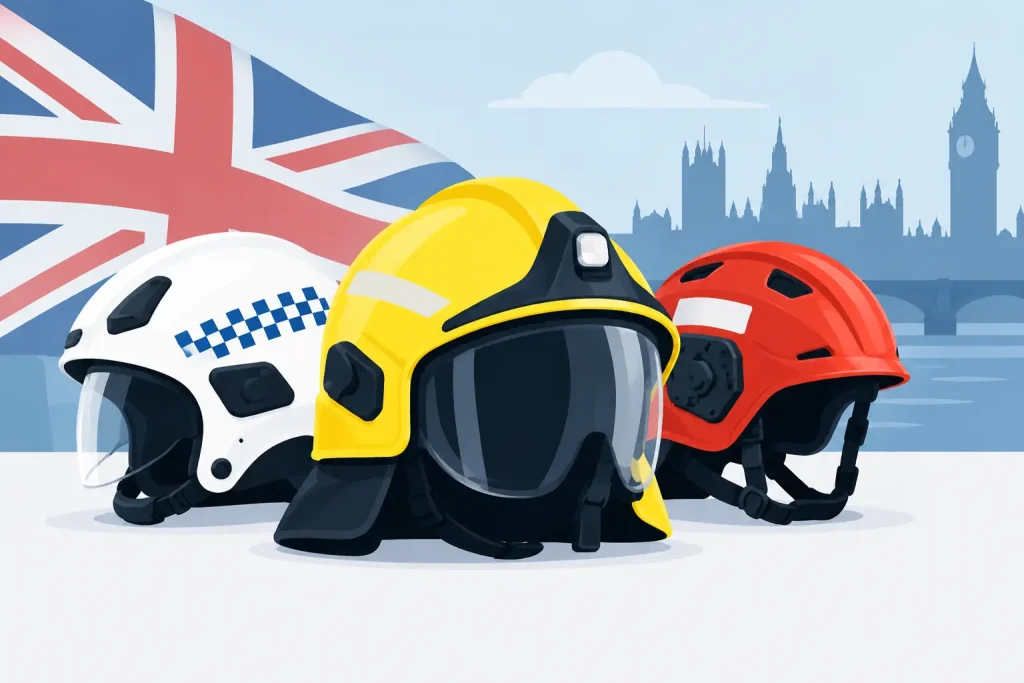
A helmet that is technically compliant but left in a locker because it is heavy, unstable or incompatible with a crew member’s equipment is not protecting anyone. The best emergency response helmets are those specified for the real hazards, worn correctly for the full task, and supported with a practical inspection and replacement programme.
For UK emergency services, this is rarely a simple catalogue decision. A crew may move from vehicle extrication to working at height, from a coastal search in driving rain to casualty care under low light. The correct helmet depends on the exposure, the role, the other PPE in use and the operational standard the organisation must meet.
What makes an emergency response helmet the right choice?
Protection begins with the hazard assessment, not with appearance. Impact from falling debris, penetration, heat and flame, electrical exposure, rope access, water operations, noise, poor visibility and prolonged wear all place different demands on a helmet system.
A structural firefighting helmet, for example, is designed for a very different environment from a technical rescue helmet. Fire crews may need heat and flame resistance, a substantial rear neck protector, eye and face protection, and compatibility with breathing apparatus. Search and rescue personnel working around cliffs, confined spaces or unstable structures may prioritise low weight, side-impact coverage, ventilation, a secure chinstrap and dependable headtorch mounting.
The best specification is therefore not necessarily the highest-priced or most feature-heavy option. It is the one that protects the wearer without compromising movement, communications, vision or task performance. Where teams undertake multiple operational roles, a procurement plan may require more than one helmet type rather than asking a single model to cover incompatible risks.
Start with the relevant standards
A recognised standard provides a baseline for performance, but it does not replace a role-specific risk assessment. Procurement teams should confirm which standard applies to the intended use and verify that the supplied configuration, including any visor or accessory, remains compliant.
For structural firefighting, EN 443 is a key European standard for helmets used in firefighting in buildings and other structures. Technical rescue and mountaineering-style helmets are commonly assessed to EN 12492, which includes retention requirements suited to work where a helmet being displaced can be a critical risk. Industrial safety helmets are often specified to EN 397, although this standard alone may not address the side-impact, retention or heat performance required for emergency response work.
These categories are not interchangeable. An EN 397 industrial helmet may be suitable for a controlled worksite task but unsuitable for rope rescue or fireground operations. Equally, a rescue helmet should not be treated as a structural firefighting helmet simply because it offers excellent impact protection.
Standards also need reading alongside the manufacturer’s instructions. Optional performance tests, accessory approvals, temperature limits and service-life guidance can materially affect a purchasing decision. Ask for current declarations of conformity and technical documentation, particularly when issuing equipment across several teams or locations.
Do not specify by standard alone
Two helmets carrying the same standard can feel markedly different in service. Shell geometry, suspension design, adjustment range and accessory interfaces determine whether protection stays correctly positioned during crawling, lifting, climbing or casualty handling.
Trial samples with representative users before committing to a large issue. Include personnel with different head sizes and hairstyles, as well as users who routinely wear prescription eyewear, communications headsets, hearing protection, respiratory protection or cold-weather hoods. A good trial reflects a real shift, not five minutes in a stores room.
Fit and retention are operational features
A helmet must sit level, remain stable when the wearer looks up or down, and resist rolling or lifting under movement. Adjustment should be achievable with gloved hands where required, without creating pressure points that become painful after several hours.
The retention system deserves close attention. Chinstraps and rear adjustment assemblies should hold the helmet securely without restricting speech, jaw movement or the seal and fit of other PPE. For work at height, in fast-moving water or around rotating equipment, an insecure helmet can become a secondary hazard.
Sizing must be managed as an issue process, not an afterthought. Measure personnel properly, record the selected size and adjustment setting where practical, and provide a fitting check at handover. This is particularly valuable for retained crews, volunteer teams and organisations with geographically dispersed personnel.
Comfort is not a soft consideration. Fatigue affects compliance. A balanced helmet with effective internal padding and an appropriate weight distribution is more likely to be worn consistently during long searches, incident command support or repeated training evolutions.
Build the helmet system around the task
Emergency helmets are often platforms rather than stand-alone items. The right accessories can improve safety, but only if they are approved for the helmet and do not create snag, balance or compatibility problems.
For low-light operations, an integrated or purpose-designed headtorch mount is preferable to improvised tape or straps. It keeps the beam stable and reduces the chance of an accessory detaching during a search. Consider the location of the battery pack, the availability of replacement batteries, the effect on balance and whether the light can be operated with gloves.
Eye and face protection need the same discipline. Clear visors can protect against dust, splashes and debris, while tinted options may assist in bright conditions. However, a visor should not impair the use of breathing apparatus, spectacles or communications equipment. Any requirement for chemical splash protection must be assessed against the relevant PPE standard and incident procedure rather than assumed from a general-purpose visor.
High-visibility colouring and reflective markings can aid team identification in darkness, smoke or poor weather. They are useful, but should complement – not replace – lighting, command procedures and personal location systems. In certain tactical or aviation environments, high visibility may not be appropriate, so colour choice must follow the operational profile.
Communications integration is increasingly important for specialist rescue, medical and flight operations. Check headset compatibility early. A helmet that accepts a headset but forces an awkward fit, blocks access to controls or creates painful pressure beneath ear defenders will undermine the purpose of the system.
Durability, care and replacement matter as much as purchase price
Helmets are exposed to UV light, salt, fuel residues, soot, cleaning agents, drops and repeated transport. These conditions can degrade components long before a shell appears visibly damaged. The shell, liner, suspension, chinstrap, visor and accessory mounts should all be inspected according to the manufacturer’s guidance.
After a significant impact, heat exposure, chemical contamination or suspected structural damage, remove the helmet from service pending assessment. Do not rely on a visual check alone. Some damage is not obvious, and field repairs using unapproved parts can invalidate the equipment’s protective performance.
A practical asset register helps teams control inspection dates, issue history, repairs and retirement. It also reduces the risk of mixed configurations where a visor, liner or attachment has been transferred between incompatible models. For organisations managing multiple stations or specialist units, this record keeping supports consistency and defensible PPE governance.
Cleaning should be controlled too. Avoid solvents, abrasive methods and unapproved disinfectants. These may damage plastics, coatings, visor materials or textile components. Establish a cleaning routine that reflects the risk of blood-borne contamination, smoke residues or saltwater exposure while following the helmet manufacturer’s instructions.
A procurement approach that protects the whole team
When selecting the best emergency response helmets, involve end users, training leads, health and safety representatives and those responsible for maintaining equipment. Define the operational scenarios first, then assess suitable certified models against fit, accessory compatibility, durability, lead times and whole-life support.
For bespoke or mixed-role teams, it may be worthwhile to standardise colour, identification markings and approved accessory packages while retaining different helmet categories for different hazards. That approach improves recognition and ordering control without forcing personnel into the wrong protection.
Rig Equipment supports operational teams with protective equipment selected around demanding service conditions, alongside practical guidance on sizing, issue and customised team presentation. The objective is straightforward: equipment should arrive ready to work, fit the user properly and perform predictably when conditions deteriorate.
The most dependable helmet decision is the one made before the incident, tested by the people who will wear it, maintained throughout its service life and reviewed whenever the role, risk or operating environment changes.