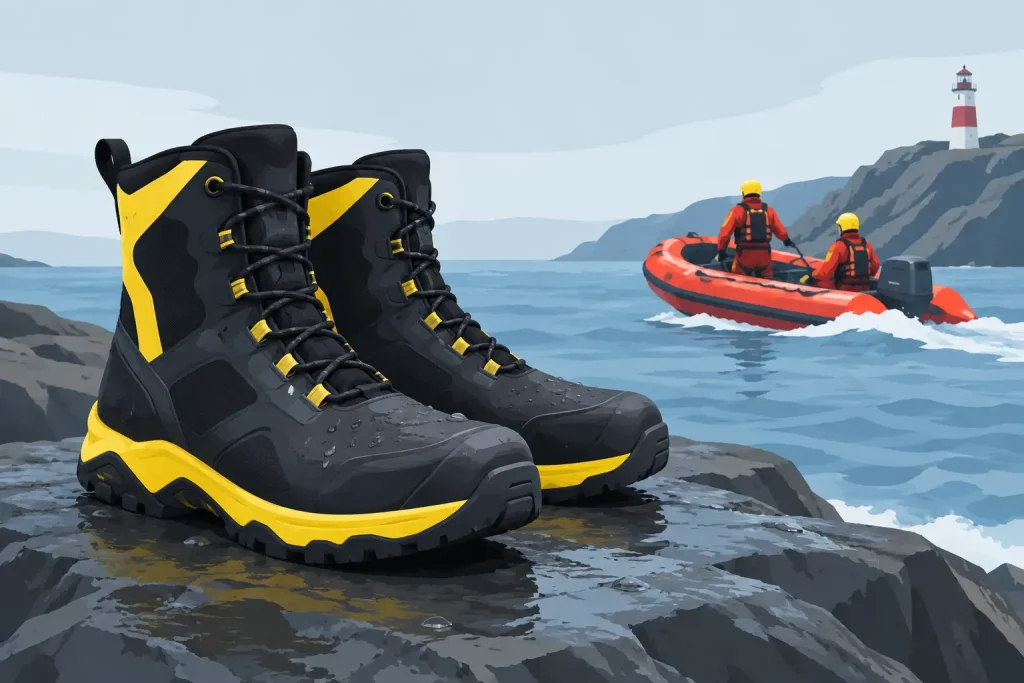
A boot failure rarely announces itself at the start of a shift. It appears as cold water working through a compromised lining, a sole that loses purchase on wet rock, or fatigue building because the fit is wrong. Waterproof rescue boots UK teams select must do more than keep out rain. They need to protect footing, support movement and remain dependable through long, exposed deployments.
For coast guard personnel, search and rescue crews, firefighters, medical responders and tactical teams, footwear is part of the operational system. The right specification depends on the ground, weather, task and required protective standard. A boot suited to station wear and roadside incidents may not be the correct choice for steep terrain, tidal slipways or prolonged work around standing water.
What Waterproof Rescue Boots UK Teams Need to Deliver
Waterproofing matters, but it is only one part of a rescue boot specification. A useful starting point is to consider the conditions in which the boot will be used most often, then assess the consequences when those conditions deteriorate. Wet grass, flooded paths, deck surfaces, loose shale, oil-contaminated hardstanding and urban rubble all demand different things from a sole and upper.
A properly specified boot should manage water ingress while maintaining support, grip and comfort. In practical terms, that means a secure lacing system, an upper that resists repeated wetting, a lining or membrane designed to move moisture away from the foot, and a sole pattern that can clear mud rather than packing solid. Protection features such as toe protection, penetration resistance, electrical properties or heat resistance should be selected against the role’s risk assessment, not added by default.
There is a trade-off. Higher-cut, more protective footwear can provide valuable ankle support and shielding from abrasion, but it may be heavier and less agile during vehicle work, ladder climbing or confined tasks. Lightweight waterproof boots can reduce fatigue on long searches, yet may offer less insulation, impact protection or stability under a loaded pack. The objective is not the heaviest boot available. It is the boot that lets the wearer work safely and effectively for the duration of the task.
Waterproof Does Not Mean Suitable for Full Immersion
This distinction is critical for rescue operations. Most waterproof boots are intended to withstand rain, puddles, wet ground and brief exposure to shallow water. Water can still enter over the collar if conditions are deeper than the boot height, and no breathable lining can compensate for water pouring in from above.
Teams operating around floodwater, surf, rivers or prolonged standing water may need a different system altogether, such as waterproof trousers integrated with suitable footwear, waders, drysuits or task-specific water-rescue equipment. The choice should follow the operational procedure and hazard assessment. Treating a standard waterproof boot as a water-rescue boot can leave personnel cold, distracted and at unnecessary risk.
Waterproof performance also changes over time. Leather and fabric uppers require cleaning and reproofing, while membranes can be compromised by damage, poor drying practices or contaminated water. A boot that has performed well for a year may no longer offer the same protection after repeated use on abrasive ground.
Grip Must Match the Surface
Slip resistance is often discussed as a single feature, but real terrain is more complicated. A sole that grips well on dry rock may perform differently on algae, wet painted steel, ice or deep mud. Deep lugs can improve traction on soft ground and aid self-cleaning, while a flatter sole may give more stable contact on ladders, pedals and hard surfaces.
For mixed-response teams, a versatile outsole is usually the sensible compromise. Look for a tread that offers a defined heel brake for descents, stable edge contact and enough spacing to shed debris. The rubber compound matters as much as the tread pattern. Soft compounds can grip exceptionally well but may wear faster on tarmac and concrete, whereas harder compounds often last longer but can feel less secure on slick surfaces.
No sole eliminates the need for sound movement techniques. Ice, diesel, loose scree and wet timber can defeat even high-quality footwear. Operational footwear should support good decisions, not encourage false confidence.
Fit Is a Safety Requirement
Poor fit creates problems long before the boot visibly fails. A heel that lifts can cause blisters and reduce stability. A cramped toe box can lead to nail damage and pain on descents. Excess internal volume allows the foot to move, increasing fatigue and the chance of rolling an ankle on uneven ground.
Fit should be checked with the socks normally worn on duty, ideally later in the day when feet are more likely to be swollen. Wearers need enough room to move their toes without sliding forward, with the heel held securely when climbing or descending. Lacing should allow adjustment across the instep and ankle, particularly for those who alternate between walking, driving and working static scenes.
Procurement teams should not assume one last will suit every member of a unit. Offering appropriate width and size options, along with professional measurement guidance, helps reduce avoidable returns and field discomfort. This is especially relevant when issuing large quantities, where a small fit problem can become a widespread readiness problem.
Check Standards Against the Actual Task
Safety standards provide a useful baseline, but they do not replace a clear specification. Depending on the operational role, buyers may need footwear certified to the relevant current safety standard, with properties for toe protection, sole penetration resistance, slip resistance, antistatic performance, heat contact resistance or other identified hazards.
Ask for clear technical information and certification evidence for the supplied model. Avoid relying on broad descriptions such as “tactical” or “all-weather” as proof of performance. A rescue boot can look capable while lacking the particular protection required for a workshop, incident ground, airfield or fire scene.
The same principle applies to waterproof claims. Understand whether the stated performance relates to a membrane, treated upper or full boot construction, and ask how it should be maintained. For organisational issue, record the approved model, specification, replacement interval and any limitations on use. That creates consistency across the team and makes future replenishment more straightforward.
Build Footwear Into the Issue Plan
Boots should be inspected as routinely as helmets, gloves and outer layers. Before deployment, check the sole for wear or separation, examine the upper and stitching for cuts, and look for damaged eyelets, failed laces and signs of water ingress. A worn heel can alter gait and reduce braking control on slopes, even if the rest of the boot appears serviceable.
After wet or contaminated work, remove mud and debris with clean water where appropriate, take out the footbeds and allow the boots to dry naturally in a ventilated area. Direct heat can dry leather excessively, damage adhesives and shorten the working life of waterproof components. Reapply a manufacturer-compatible treatment when the upper stops shedding water or following cleaning, according to the material used.
For managers, a planned replacement approach is more reliable than waiting for a failure at an incident. High-mileage personnel, staff regularly exposed to saltwater or contaminants, and those working uneven terrain will wear footwear at different rates. Retaining a small buffer of approved sizes can prevent a damaged pair becoming a reason to deploy in unsuitable footwear.
Selecting a Supplier That Understands Operations
The strongest purchasing decision balances individual comfort with repeatable team performance. That means working with a supplier that can provide accurate sizing support, transparent technical information and continuity of supply where possible. It also means being able to discuss the environment and duty profile rather than choosing solely by appearance or price.
Rig Equipment supports operational teams with specialist clothing and protective equipment shaped around demanding conditions, alongside practical help with measurement, replacement and organisational issue requirements. For bespoke uniform programmes, footwear should be considered alongside trouser interfaces, weather layers and the way personnel actually move during a shift.
The most useful question is simple: will this boot still protect the wearer when the route gets steeper, the weather turns and the job runs longer than planned? Choose the pair that can answer that question with evidence, correct fit and proven care – then keep it ready for the next call.