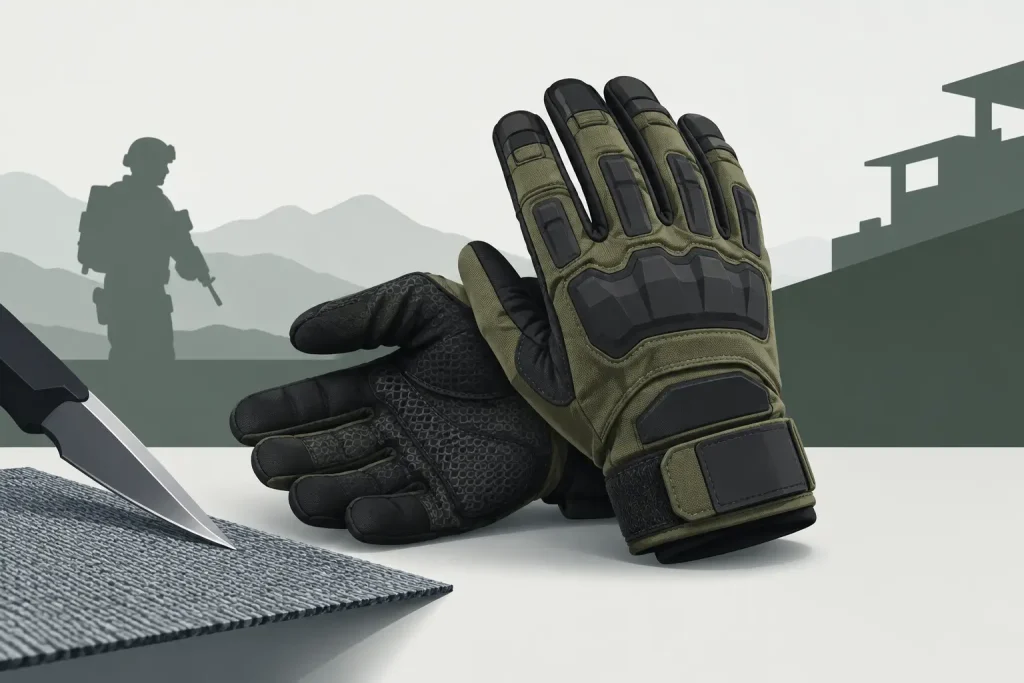
A glove can prevent a minor handling injury from becoming a casualty, but only when it protects the right area without compromising the task. Cut resistant tactical gloves are specified for crews and operators who may handle damaged vehicles, sharp metal, broken glass, tools, rope, equipment housings or edged threats while retaining control of radios, weapons, medical equipment and vehicle controls.
The correct choice is not simply the glove with the highest cut rating. Operational hand protection is a balance of credible cut resistance, grip, dexterity, fit, durability and compatibility with the wider system of work. A search and rescue team working around wreckage has different priorities from a tactical operator conducting a search, and both differ from a fire and rescue crew dealing with wet, contaminated debris.
Start with the actual hand hazard
Cut resistance describes a material’s ability to resist being cut under controlled test conditions. It does not make a glove puncture-proof, needle-proof, impact-proof or suitable for deliberate contact with a moving blade. It also does not protect every part of the hand equally. Many tactical designs focus reinforcement and protective liners in the palm and fingers, where the most frequent handling hazards occur, while using lighter materials elsewhere to preserve movement.
A proper risk assessment should identify what causes the potential injury, how force is applied and which part of the hand is exposed. Sharp sheet metal and broken glazing present a different challenge from a serrated edge, a protruding cable tie or a hypodermic needle. Consider whether the glove may be wet, oily, covered in fuel, exposed to heat, or worn for an extended shift. These conditions can change grip and can also affect how readily a glove can be removed or inspected.
Procurement teams should avoid specifying cut level in isolation. A glove that performs well in a laboratory may be unsuitable if its surface becomes slippery in rain, its cuff catches on equipment, or its liner is too thick for essential fine work.
Understanding cut resistance standards
For operational buyers in the UK, EN 388 is the key reference point for protection against mechanical risks. The standard records performance against abrasion, blade cut, tear and puncture, with additional testing where applicable. Cut performance can be shown through the traditional rotating blade test and, where required, the TDM test under EN ISO 13997.
The TDM result is especially relevant for high-cut materials because it measures the force required to cut through the sample with a straight blade. It is normally expressed from A to F, with higher letters indicating greater resistance in the test. That result is useful for comparing tested materials, but it is not a prediction that a wearer can safely apply a particular amount of force to any sharp object.
Ask for the full marking and supporting technical information rather than relying on broad descriptions such as “cut-proof”. Check whether the stated rating applies to the glove model and size range being supplied, not merely to a liner or an individual fabric component. Where a task includes other hazards, assess relevant requirements separately, including impact protection, thermal performance, flame resistance, chemical resistance or electrical risks.
Ratings support decisions, not shortcuts
A higher rating often brings a trade-off. Dense protective yarns and additional layers can increase bulk, reduce tactile feedback and retain more moisture. For casualty care, communications work or weapon handling, a mid-level protective glove with better fingertip control may reduce overall operational risk more effectively than a heavily lined model that users remove when precision is needed.
Fit and dexterity determine whether gloves stay on
A glove only protects the hand when it is being worn correctly. Excess material at the fingertips reduces control and can snag. A glove that is too tight restricts circulation, increases fatigue and may split at stress points. Poor thumb construction is particularly noticeable when operating radios, fastening webbing or applying dressings.
Issue a meaningful size range and give personnel the chance to try gloves during representative tasks. They should be able to close a fist, operate a torch switch, retrieve equipment from a pouch, manage a zip and use communications controls without excessive effort. For tactical users, test the glove with issued equipment rather than a generic training substitute.
Cuff design matters as well. A close-fitting cuff can reduce snagging and help keep debris out, while a longer cuff may offer better overlap with sleeves and additional coverage around the wrist. The appropriate choice depends on the garment system, the likelihood of exposure to sharp surfaces and whether rapid donning is a priority.
Selecting cut resistant tactical gloves by role
There is no single tactical glove for every service. Teams should define a small number of approved options where the operating roles genuinely differ, rather than issuing one compromised design to everyone.
For search and rescue, recovery and scene safety work, look for reliable palm protection, secure wet grip and construction that withstands rough surfaces. Reinforcement at high-wear zones is valuable, but it should not make rope handling or equipment checks unnecessarily cumbersome.
For defence and security operations, the balance often moves towards dexterity, control and low-profile fit. Gloves must work with individual equipment, vehicle interiors and communications systems. If impact protection is required, assess whether rigid or moulded features interfere with weapon manipulation, confined-space work or a casualty search.
Medical responders may need cut protection for extrication support or contaminated scenes, but they also require a clear glove-change procedure. Protective tactical gloves are not a substitute for appropriate disposable medical gloves where infection control is required. In some situations, a correctly selected system of outer protective gloves and disposable gloves is the practical answer, provided dexterity and tear risks have been assessed.
For fire and rescue personnel, structural firefighting gloves and technical rescue gloves serve different purposes. A cut resistant tactical glove should never be treated as an alternative to gloves certified for the heat, flame and water conditions of firefighting. Match the glove to the incident phase, then ensure crews understand when to change systems.
Grip is a safety feature
Grip is often discussed as comfort, when it is more accurately a control issue. A secure hold on a wet ladder rail, casualty stretcher, tool handle or vehicle component reduces the need to over-grip. Less force through the hand can improve endurance and lower the chance of a slip bringing the palm into contact with a sharp edge.
Assess palm materials in the conditions that crews encounter. Synthetic leather may provide dependable handling and abrasion resistance, while textured coatings can offer strong grip in specific environments. Neither is universally better. Some materials stiffen when wet, some become less effective around oils and fuels, and some coatings wear quickly when repeatedly used against rough surfaces.
Inspection, replacement and care
Gloves are consumable protective equipment. Cut-resistant fibres can be damaged by abrasion, snagging, heat, chemical exposure and repeated laundering. Damage may not be obvious from a quick glance, particularly on the inside of fingers or along seams.
Personnel should inspect gloves before use and after a significant contact with sharp material. Check for holes, thinning palms, loose stitching, cuts through outer layers, hardened sections and contamination that cannot be safely removed. A glove that has stopped a serious cut should be removed from service unless it has been inspected and confirmed suitable under the organisation’s procedure.
Follow the manufacturer’s cleaning instructions. Incorrect washing temperatures, unsuitable detergents or forced drying can affect fit, coatings and fibres. Keep a clear replacement route for individual users and an agreed stock level for teams. Equipment that is difficult to replace is more likely to be used beyond its safe service life.
Make the specification work on scene
The strongest procurement specification is one shaped by operational trials. Put candidate gloves into the hands of representative users, test them in wet and cold conditions where possible, and record feedback against defined tasks rather than personal preference alone. Include durability after repeated use, ease of sizing, compatibility with issued kit and the clarity of certification evidence.
Rig Equipment’s approach to protective equipment is built around the same principle: the item must earn its place in the operational system, not merely meet a catalogue description. Select gloves that users can wear for the full task, train teams on their limits, and replace them before wear becomes a risk. That is how hand protection supports readiness when the scene is unforgiving.