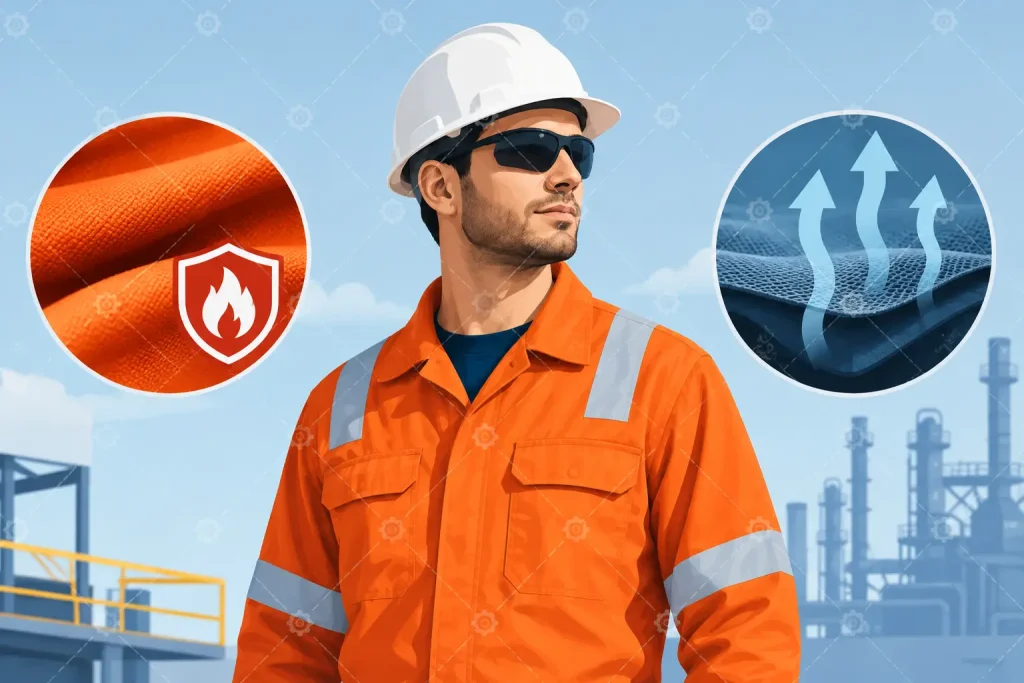
A flight crew member working a hot turnaround, a coastguard team moving equipment ashore, or a wildland firefighter on a long ascent faces the same practical question: are flame resistant fabrics breathable enough to work in for hours? The answer is yes, often, but breathability is not guaranteed by an FR label. It depends on the fibre system, the fabric weight and construction, the garment design, the layers worn beneath it, and the conditions in which the wearer is operating.
For operational teams, comfort is not a cosmetic consideration. When clothing traps heat and moisture, concentration, movement and endurance can all be affected. The requirement is to manage that burden without compromising the certified thermal protection needed for the task.
Are flame resistant fabrics breathable?
Flame resistant fabric can be breathable, but it is not automatically as breathable as a lightweight non-protective shirt. Fire and heat protection asks fabric to do more than ordinary workwear: resist ignition, limit flame spread, reduce heat transfer and maintain performance after exposure. Those requirements can add density, specialised fibres, treatments or protective layers that influence how readily heat and perspiration move away from the body.
Breathability is also an imprecise term. In day-to-day use, people generally mean that a garment feels less clammy and allows sweat to evaporate. Technically, this involves several separate properties. Air permeability describes how easily air passes through a fabric. Moisture vapour transmission describes how well water vapour can move through it. Thermal resistance and evaporative resistance indicate how much a clothing system slows heat loss and sweat evaporation.
A fabric may allow little direct airflow yet still move moisture vapour effectively. Conversely, an open, light fabric may feel airy but offer less protection from radiant heat, wind or weather. The correct balance is determined by the hazard assessment, not by selecting the lightest option available.
Why some FR garments feel hotter than others
The first distinction is between inherently flame resistant fabrics and fabrics given an FR treatment. Inherent FR fibres have their resistance built into their chemical structure. Their protective properties are designed to remain throughout the service life of the garment when correctly cared for. Treated fabrics use a finish applied to a base material, often cotton-rich, to provide flame resistance.
Neither category is inherently cooler in every application. A well-engineered inherent fabric can offer excellent moisture management and long-term performance, while a treated fabric can be comfortable and familiar in feel. Fabric construction, weight and finish are often more influential than the broad category alone. Procurement teams should assess the complete technical specification rather than assuming one route is always more breathable.
Weight matters. A heavier fabric generally carries a greater heat burden than a lighter one, although it may be necessary where abrasion, flash fire exposure, durability or environmental protection demand it. A close weave can improve durability and provide some wind resistance, but may reduce airflow. Stretch panels, reinforced zones, pocket layouts and waterproof membranes also affect how heat and moisture are managed across the whole garment.
The work rate matters just as much. Personnel standing on a cold airfield may need insulation and wind protection. The same personnel moving casualties, lifting kit or working under a helmet and load carriage may generate significant body heat within minutes. Clothing needs to perform through both states, not simply feel comfortable when first put on.
Protection comes before perceived coolness
In hazardous roles, a garment must never be selected solely because it feels cooler. Some commonly used performance fabrics can melt, drip or shrink under heat exposure. This can increase injury risk, particularly when clothing is worn as a base layer beneath an FR outer system.
The full clothing ensemble must be considered. An FR jacket over a non-FR polyester base layer does not create a fully protective system. Equally, adding non-approved waterproofs, fleece layers or high-visibility garments can change the protection, breathability and mobility of the original clothing configuration.
This is particularly relevant where teams work across changing environments. Search and rescue personnel may move from vehicle-based response to exposed ground operations. HEMS and air ambulance crews may work in confined aircraft cabins, then attend incidents in poor weather. Wildland teams may face high exertion, solar exposure, smoke and rapidly changing wind conditions. One garment cannot remove every trade-off, but a properly specified layering system gives the wearer more control.
Build breathability through the layering system
A breathable FR system begins next to the skin. Base layers should move moisture away from the body while remaining appropriate for the thermal risk. If the next-to-skin layer retains perspiration, it can leave the wearer damp and chilled during lower activity, while making the entire system feel hotter during exertion.
The mid-layer should add warmth only when conditions require it. Bulky insulation may be necessary for static exposure, but it can quickly become unsuitable for high-output work. A lighter FR mid-layer, used with a shell that can be opened, removed or adjusted when safe to do so, often gives better operational flexibility.
Outer layers provide the greatest protection from weather and external hazards, but they can also create the greatest barrier to moisture transfer. Flame-retardant stormwear with waterproof and windproof properties has a vital role in exposed operations. However, any waterproof barrier reduces air exchange to some degree. Ventilation features, compatible underlayers and sensible task-based clothing changes help manage the resulting heat load.
Fit is part of this system. Clothing that is too tight can restrict movement and limit the insulating air space intended by its design. Clothing that is excessively loose can snag, interfere with equipment and make layering harder to regulate. Female-fit options and a comprehensive size range are operational considerations, not merely matters of appearance. Better fit supports reach, mobility, comfort and more consistent use of the intended protective layers.
Garment design can make a measurable difference
Two garments made from a similar FR fabric can perform very differently in use. Design details determine whether the wearer can release excess heat and continue moving freely without compromising protection.
Useful features may include controlled ventilation in lower-risk areas, adjustable cuffs and collars, articulated sleeves, practical pocket placement and closures that remain manageable with gloves. The location of reinforcement is also significant. High-wear areas need durability, but covering large sections of the garment with dense reinforcement can create heat-retaining zones.
Headwear, gloves, footwear and body armour or buoyancy equipment should also be considered. Heat stress is a whole-system issue. A well-performing shirt cannot compensate for an over-insulated, poorly fitted or incompatible equipment set.
How to assess breathable FR clothing for a team
Product data is essential, but field use provides the final test. Confirm the relevant protection standards and the scope of certification first, then consider fabric weight, fibre composition, construction and any membrane or coating. Ask what the garment is intended to protect against and what it is not designed to do.
Next, assess the actual duty cycle. Consider ambient temperature, humidity, wind, solar load, expected work rate, task duration, vehicle or aircraft time, required PPE, washing regime and the need for cold-weather layering. A garment that works well for an indoor technical role may be unsuitable for coastal response or prolonged summer deployment.
Wear trials should involve the people who will use the kit, including a representative range of body shapes and roles. Test mobility while reaching, kneeling, carrying, climbing and working with issued equipment. Record where heat accumulates, whether sweat dries during lower activity, and whether the garment continues to sit correctly after repeated movement. Feedback should be specific enough to inform a revised specification rather than reduced to a simple judgement of ‘too hot’ or ‘comfortable’.
Care instructions deserve equal attention. Contamination with oils, fuels, dirt or unsuitable laundry products can affect garment performance and wearer comfort. Consistent inspection, laundering and repair processes help retain the properties for which the clothing was selected.
The practical answer for operational users
Breathable FR clothing is achievable, but it is a balance rather than a single feature. The most suitable system is the one that provides verified protection for the identified hazard while allowing the wearer to manage heat, moisture and movement during real operational work.
For teams working across severe weather, high exertion and heat-related risk, the strongest specification starts with the task and builds outward: certified materials, the right fabric weight, compatible layers, accurate fit and a design tested by the people who depend on it. When clothing allows personnel to stay protected, mobile and focused through a full shift, it is doing the work it was issued to do.