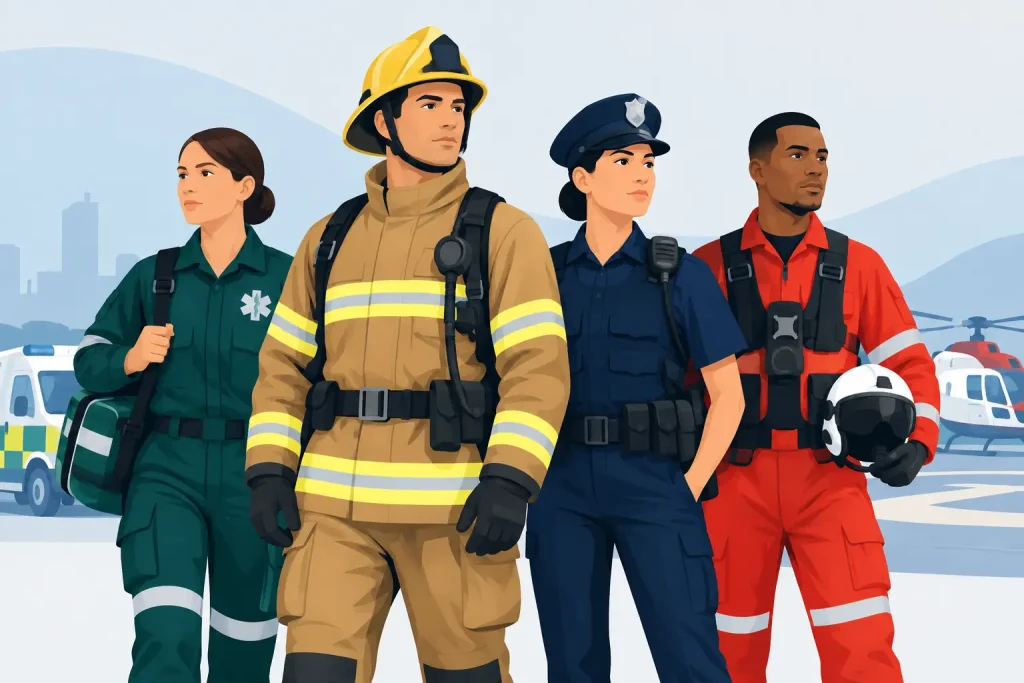
A uniform failure rarely begins with a dramatic tear or broken fastening. More often, it starts with a sleeve that restricts a casualty carry, a collar that chafes beneath a lifejacket, or a poor fit that encourages a responder to remove a vital layer. Bespoke emergency service uniforms address these operational details before they become distractions in difficult conditions.
For procurement leads and operational commanders, bespoke does not mean cosmetic. It means specifying clothing around the real work of the team: exposure to wind, rain, heat, flame risk or contamination; the equipment worn over it; the range of movement required; and the need for every wearer to look professional and identifiable. The result should be a uniform system that supports protection, readiness and service pride without compromising mobility.
Why standard workwear is not always enough
Off-the-shelf workwear can be appropriate where the task is predictable and the working environment is controlled. Emergency services rarely operate on that basis. A coastguard team may move from a vehicle to a wet shoreline, then work beside water in driving rain. A fire and rescue crew may require garments that work with protective layers, helmets, gloves and breathing apparatus. Flight and medical personnel may need low-bulk clothing that remains practical during long shifts, transfers and confined working positions.
A standard garment can be well made yet still be wrong for the role. Pocket placement may conflict with a harness. Fabric weight may be unsuitable for the local climate or the pace of activity. A generic sizing run may leave some team members with excess material that catches on equipment, while others have too little reach through the shoulders and knees.
Bespoke development creates the opportunity to resolve these issues deliberately. It also helps organisations maintain a consistent operational appearance across mixed roles, sizes and deployments.
Bespoke emergency service uniforms start with the task
The strongest uniform specifications begin with job analysis, not a catalogue page. Before selecting fabrics, colours or badges, establish what happens during a normal shift and what happens on the worst day.
Consider the physical demands of the role. Does the wearer climb ladders, work at height, kneel beside casualties, operate in water, drive for extended periods or carry technical equipment? Those answers influence garment cut, reinforcement, articulation and adjustment points. They also determine whether a uniform should be built as a single layer or as part of a modular clothing system.
Environmental exposure matters just as much. Cold, wind and persistent rain demand a different approach from high heat, flash-fire risk or indoor clinical work. Protection must be appropriate to the assessed hazard, and any claimed performance should be supported by suitable certified materials and relevant testing. More protection is not automatically better if it causes heat stress, restricts movement or makes the garment unsuitable for the actual task.
The final consideration is interoperability. Uniforms do not work in isolation. They must function with personal protective equipment, body armour, flotation devices, radios, belts, gloves, helmets and footwear. A jacket that is excellent on its own can become impractical once a harness covers the pockets and a radio antenna catches at the collar.
Fit is a safety and performance issue
Fit is often treated as an administrative matter: collect sizes, place the order, distribute garments. For operational clothing, that approach is too narrow. Fit affects thermal comfort, dexterity, freedom of movement and the wearer’s willingness to use equipment correctly.
A well-designed bespoke garment accounts for different body shapes without making assumptions about a single ‘standard’ wearer. It can offer appropriate sleeve and leg lengths, sufficient reach across the back, room for layering and adjustment where it is genuinely useful. For specialist teams, professional measurement guidance can prevent recurring problems before production begins.
This is particularly valuable where teams include a wide range of sizes, or where a garment must accommodate specific equipment. It also reduces the costly cycle of issuing unsuitable kit, arranging alterations and holding excess stock that never gets worn.
There is, however, a balance to strike. Too many individual variations can make replacement issuing harder and reduce consistency across the team. The practical answer is usually a controlled specification: common core garments, defined options for role-specific needs, and accurate wearer records to support repeat orders.
The detail that separates a uniform from a system
The operational value of bespoke clothing is often found in the small decisions. A reinforced knee is useful when it aligns with the kneeling position. A storm flap matters when it remains secure in high wind. A two-way zip can improve access to trouser pockets or equipment, but only when it is durable and simple to operate with gloved hands.
When reviewing a proposed design, procurement teams should test four areas in realistic conditions:
- movement while lifting, reaching, climbing, kneeling and driving;
- access to radios, medical equipment, identification and essential tools;
- comfort across a full shift, including wet, cold or high-output work; and
- compatibility with the full PPE ensemble, not just the garment itself.
A wear trial is one of the most useful stages in the process. It should involve the people who will use the clothing across different roles and body types, rather than relying solely on management approval. Feedback needs to be specific. ‘The jacket feels wrong’ is less useful than ‘the chest pocket cannot be accessed when the flotation device is fastened’.
Identity, visibility and professional presentation
Emergency service uniforms must communicate authority quickly. Clear service identification reassures the public, supports multi-agency working and helps teams identify one another in low light, poor weather and crowded scenes.
This does not mean adding branding everywhere. Identification should be placed where it remains visible when outer layers and equipment are worn. Embroidery, printing and woven badges need to withstand laundering, abrasion and routine operational use. Colours and reflective elements must be selected with the working environment in mind, not simply for appearance.
There can be competing demands. High visibility may be essential for roadside, aviation or water-based work, while tactical or security-sensitive operations may require a more restrained presentation. A bespoke programme allows those needs to be managed under one controlled service identity rather than forcing every team into the same garment.
Procurement should account for the full life of the garment
The purchase price of a uniform is only one part of its cost. A lower-cost garment that loses shape, fades, fails at stress points or cannot be repaired may prove more expensive through replacements, downtime and inconsistent presentation.
A sound specification considers expected service life, wash and care requirements, available repairs and alterations, and the ability to obtain matching replacements later. This matters when organisations issue kit over several years or need to replace a single damaged item without changing the appearance of the whole team.
Flexible ordering is equally important. Large framework quantities may suit a major rollout, but emergency services also need a route for new starters, changing roles, urgent replacements and specialist one-off requirements. No minimum order quantity can be a practical advantage when it is paired with consistent patterns, fabrics and branding controls.
British-based design and manufacture can also make communication, sample review and ongoing adjustment more direct. Rig Equipment combines this approach with specialist development, measurement support, production, alterations and repair services for organisations that need more than a standard uniform issue.
Building a specification that lasts
The most dependable bespoke uniform programmes are not built around a single garment. They are built around a clear understanding of risk, role and replacement. Start with the environment and task, validate fit through wear trials, then document the approved design in enough detail that future orders remain consistent.
Keep the wearer involved after issue. A short review after early operational use can reveal whether adjustments are needed to pocket access, sizing, layering or durability. Small corrections made early are far more manageable than a full redesign after an unsuitable garment has been issued across a service.
When uniform is treated as operational equipment rather than branded clothing, the buying decision becomes clearer. The right specification gives personnel fewer compromises to manage, allowing them to focus on the incident, the casualty and the team beside them.